

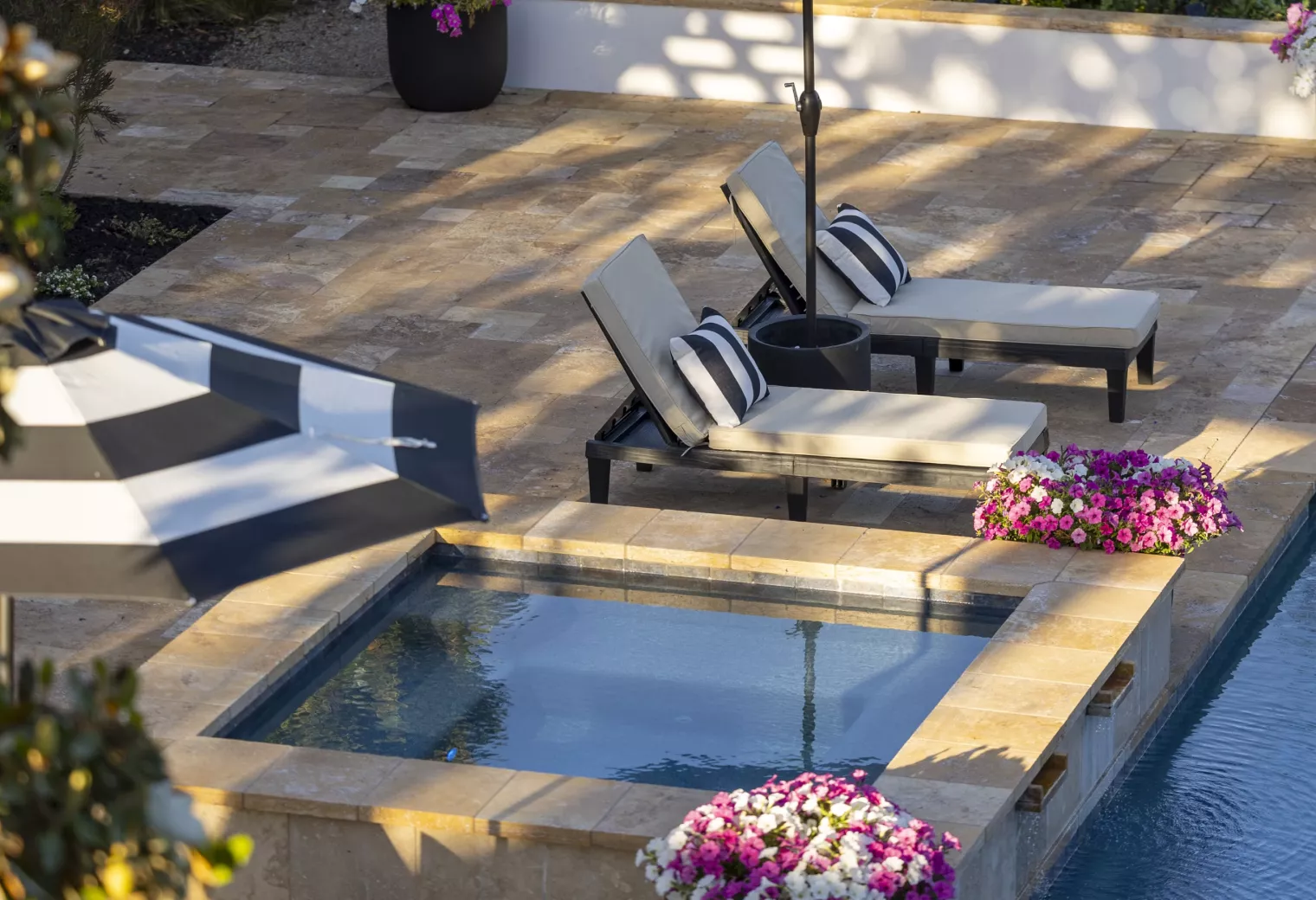
The best pool coping ideas for South Florida start with a 12-inch cap of travertine, porcelain, or precast concrete set with a slight outward pitch – because that edge has to survive salt systems, UV, and afternoon downpours before it ever has to look good. Travertine and porcelain lead the field here for heat and slip performance; concrete and brick still work when properly sealed on a realistic schedule.
From Port St. Lucie through Martin, Palm Beach, and Indian River counties, the coping choices that fail tend to fail the same way: unsealed porous stone wicking salt, dark concrete too hot to sit on by 2 p.m., and pitch set flat instead of tilted toward the deck drains.
Before comparing materials, it helps to know exactly what that cap is doing structurally.
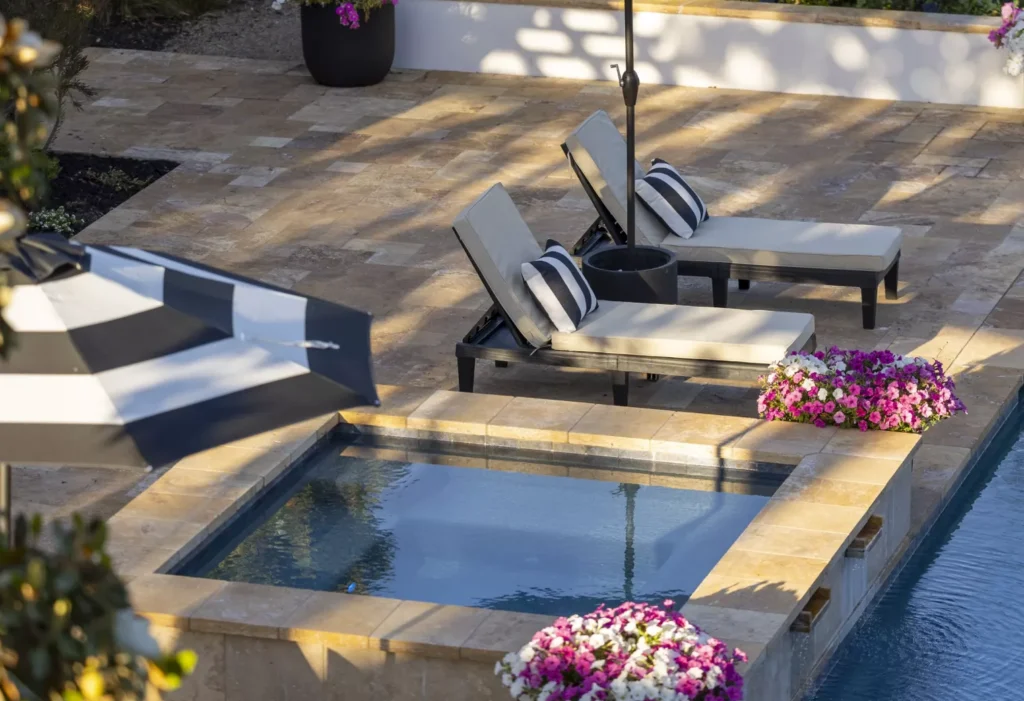
What Pool Coping Is And Why It Matters in South Florida
Coping is the cap that sits on top of your pool’s bond beam – usually a 12-inch band of stone, porcelain, or concrete that extends an inch or so over the water as a small lip. It seals off the bond beam and any protruding rebar tips, gives swimmers something solid to grab, and gets set with a slight outward tilt so splashout runs toward your deck drains instead of down behind the shell. Water getting behind that shell is one of the more common causes of structural pool damage, which is why the edge detail isn’t just decoration.
Now add South Florida to the equation. Salt air, relentless UV, high humidity, and constant thermal cycling break down bonding agents and surface sealers faster here than almost anywhere inland, and an August afternoon downpour can dump significant rainfall on that edge in a short burst, far more than many northern pools see over a much longer stretch.
That’s why good Florida pool coping ideas start with performance. The swimming pool coping ideas that last are the ones engineered for heat, salt, and drainage first.
Once you understand what coping has to do structurally, the next question is which materials actually survive that job in a Florida backyard.
Best Pool Coping Materials for Florida Pools
Travertine reflects heat, stays barefoot-friendly, and drains for traction – seal every one to two years. Concrete pool coping ideas are affordable and versatile, but they crack and turn slick.
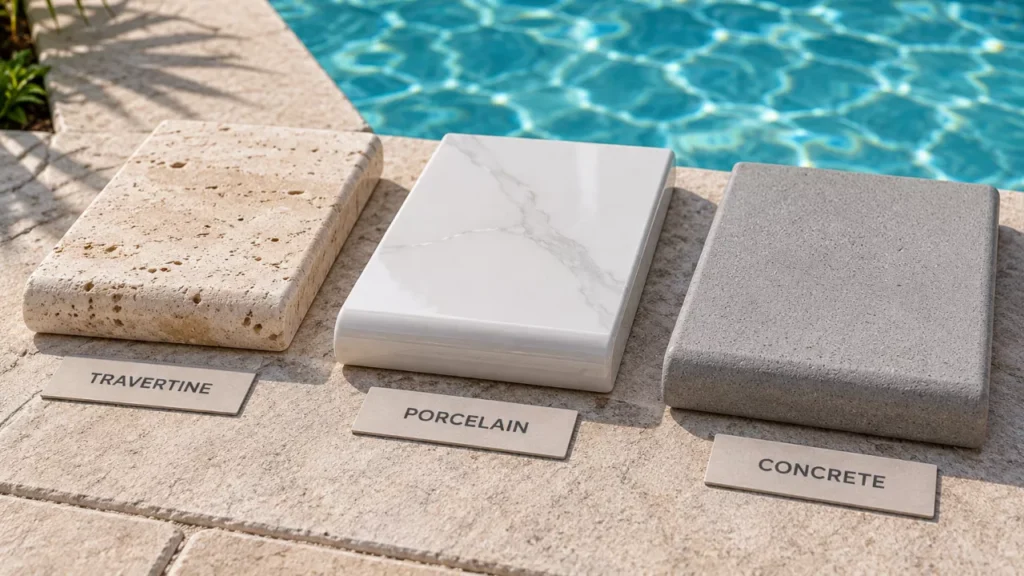
Non-porous porcelain coping shrugs off salt, mold, and UV fading, but it’s brittle and needs precise cuts.
| Attribute | Travertine | Porcelain | Concrete |
| Heat underfoot | Stays coolest | Stays cool | Absorbs heat |
| Slip resistance | Naturally high | High when textured | Slick when wet |
| Sealing | Every 1–2 years | None needed | Periodic sealing |
Marble is refined but acid-sensitive; brick reads traditional. Granite resists fading, coral stone stays cool – natural stone pool coping options; pair with your custom pool features and finishes.
For most South Florida homeowners prioritizing barefoot comfort, travertine remains a popular choice. For homeowners who want a cleaner, modern look with minimal maintenance, porcelain coping is often a better fit.
Which Pool Coping Is Best for Your Backyard?
| Goal | Recommended Option |
| Coolest barefoot surface | Travertine |
| Modern minimalist design | Porcelain |
| Luxury appearance | Marble |
| Budget-conscious renovation | Concrete |
| Traditional pool style | Brick |
Popular Pool Coping Edge Profiles and Finishes
The profile is the shape of that front edge, and it changes how the pool feels every time someone hangs on it.
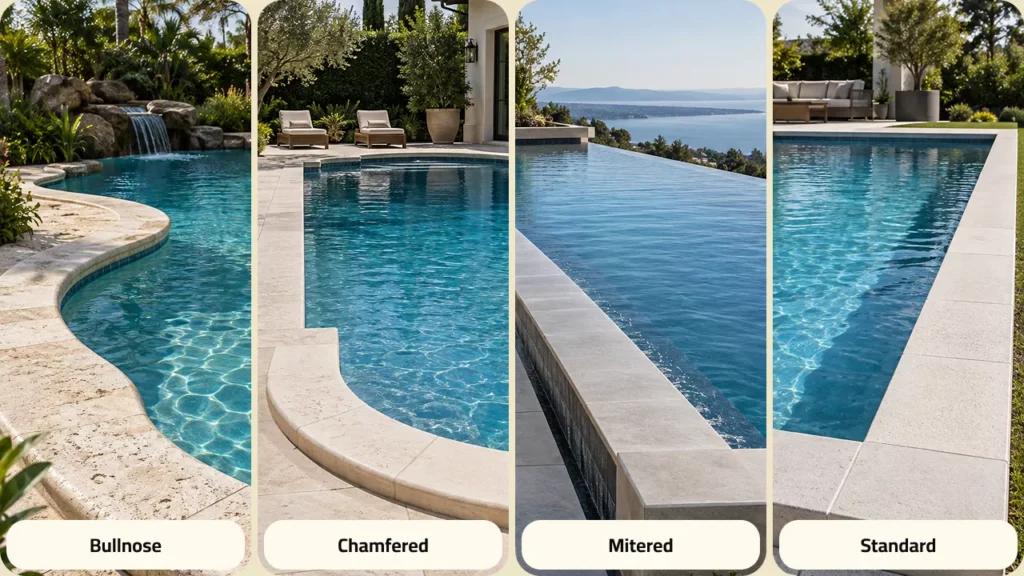
Bullnose is the fully rounded edge – a smooth semicircular curve, usually a 5cm lip on travertine, that softens the perimeter and gives kids and tired swimmers something forgiving to grip. It’s the safety-forward default around Palm Beach and Indian River backyards.
Travertine bullnose pool coping remains one of the most popular choices for South Florida pools because it combines a softened edge profile with natural heat resistance and a comfortable surface for barefoot use.
A square edge reads crisp and architectural, the front face meeting the top at a clean angle. Most builders ease that corner slightly, so shins and elbows survive a busy Saturday.
Mitered edges join two precisely angled pieces so the seam disappears, creating one continuous line down a rectangular pool. Beautiful, but it lives or dies on fabrication tolerances.
Cantilever coping is a different animal: the deck material overhangs the pool wall with no separate cap piece. It sheds water cleanly and looks seamless.
Finish matters more than profile for safety. A tumbled or textured surface – unfilled travertine, natural cleft stone, textured porcelain – grips wet feet. Ask your contractor for the DCOF slip rating before committing to any pool tile and coping ideas you’ve saved.
Next: what’s trending for 2026 pool builds.
Modern Pool Coping Ideas & 2026 Trends
Wide-format porcelain slabs are the headline right now. Running the same large-format porcelain as both coping and deck erases the visual seam, so the eye reads one continuous plane from the slider to the water – and because porcelain doesn’t absorb moisture, it won’t hold that green film shaded corners get in August.
Matte square-edge minimalism is the second big move. Matte surfaces kill the glare that makes a polished deck unusable at 2 p.m. in Wellington, and a lightly eased square edge keeps the line sharp without punishing shins.
Not every backyard wants that. Tumbled marble coping gives you a softer, honed look with real grip when wet, and it pairs cleanly with complementary pavers.
Mixed-material contrast is the other direction worth considering: dark coping framing a light deck, or the reverse. Done deliberately, it outlines the pool’s geometry beautifully – done casually, it just looks mismatched.
These modern pool coping ideas work best when you choose them alongside your modern pool design ideas, not after. Submitting an inquiry for a free quote is the easiest way to price out modern pool coping options for your yard.
Trends aside, your pool’s shape still dictates which coping style makes sense.
Choosing Coping for Your Pool Shape & Style
Freeform and lagoon pools live on curves, and a bullnose profile follows those radii without forcing awkward cuts every few feet. Tumbled travertine in short lengths handles the bends cleanly – the same logic behind most lagoon-style pool design guide recommendations.
Roman and Grecian pools are the opposite temperament. Those arched ends and chamfered corners read formal, and stone coping is what sells it – travertine framing glass waterline tile is a combination that still looks right decades later. The alcoves at a Roman end also make natural spots for entry steps or a spa bench.
Infinity-edge and tanning-ledge pools require more planning because the edge is part of the pool’s visual and structural design. The overflow wall, coping, tile, and surrounding deck must all work together. Pick the overflow edge early; it drives wall geometry and the coping spec.
Rectangular, geometric, and lap pools are where mitered porcelain earns its keep, with one unbroken line down the long run. Beach-entry designs blur that edge entirely – worth discussing alongside custom residential pool and spa design and pool grotto ideas when you’re weighing swimming pool coping ideas.
Shape decides the style, but budget decides what’s actually realistic, so let’s talk cost and durability.
Pool Coping Cost, Durability, And Paver Options
Budget $6–$15 per linear foot for concrete coping, and considerably more for natural stone like travertine, which commands a premium over concrete. Concrete pool coping ideas stretch a budget; the premium buys cooler, grippier surfaces.
| Attribute | Concrete pavers | Travertine | Porcelain pavers |
| Cost per linear foot | Lowest tier | Highest tier | Mid to upper tier |
| Heat underfoot | Absorbs heat | Stays coolest | Low heat absorption |
| Salt and UV wear | Fades and spalls | Needs sealing | Essentially unaffected |
| Best fit | Tight budgets | Barefoot comfort | Modern low upkeep |
Porcelain behaves best long-term: non-porous, mold-resistant, salt-proof. Pool coping tiles can serve as a design accent, especially when you coordinate the pool edge with waterline tile, interior finishes, and surrounding deck materials.
Pool coping pavers give homeowners more flexibility when matching the coping with the surrounding deck, especially during larger patio renovations where the pool edge and outdoor living space are updated together.
Slip resistance and heat matter too. Factor coping into your total inground pool cost in South Florida. Final coping costs depend on material selection, edge profile, pool shape, demolition requirements, backyard access, and whether the coping is part of a larger pool renovation.
Free quotes give per-foot numbers. Every coping eventually needs replacing – here are the signs.
When And How to Replace Pool Coping
Budget for a wide range per linear foot, with precast concrete on the affordable end and natural stone like travertine at the premium end, depending on how much edge has let go.
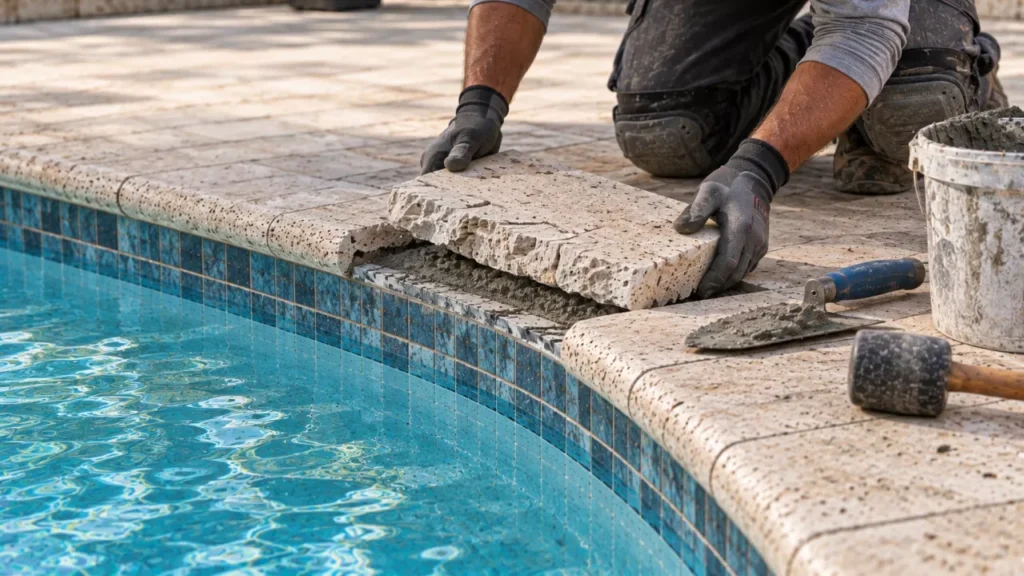
Hairline cracks patch fine. Replace once spalling flakes stone away, 20–25% of pieces are loose, or a crack swallows a credit card – water’s already behind the shell.
Watch for efflorescence, rust staining underneath, water loss, deck cracks. Salt crystallizes in travertine and limestone, fracturing it from within – salt spalling. For homeowners considering inground pool coping replacement, the process should also evaluate the deck, drainage, and waterline tile.
Not a weekend job. Masons lift failed units with air chisels and diamond grinders without cracking the bond beam, then reset stone in fresh mortar at correct height and outward pitch. With the waterline exposed, it’s the moment to revisit pool tile and coping ideas through pool coping and deck renovation services – pool coping ideas you shelved become affordable.
Sapphire’s Pool Coping Installations Across South Florida
Across builds from Port St. Lucie down through Martin, Palm Beach, and Indian River counties, the pattern repeats: weak coping choices tend to announce themselves fairly quickly in South Florida’s climate. Salt systems wick into unsealed porous stone, August sun bakes dark concrete until nobody wants to sit on the edge, and a single season of afternoon storms finds every spot where the pitch was set flat instead of tilted toward the deck drains.
In this climate, travertine, marble, and porcelain coping perform well for durability and comfort, while precast concrete and brick remain viable options when paired with a realistic sealing schedule and budget constraints.
The other habit worth adopting: coping never gets picked alone. On a licensed and insured Florida build, the cap is chosen in the same conversation as the waterline tile, the interior finish, the deck pavers, the raised wall spillways, and the drainage plan – whether it’s new construction or a remodel of a twenty-year-old kidney pool.
Get those pieces talking to each other, and your edge is built for real life.
Bringing Your Pool Coping Ideas Together
The edge of your pool does more work than almost any other surface back there. It caps the bond beam, sheds splashout toward the deck drains, and takes the brunt of every wet hand and bare foot from May through September.
So pick it the way a builder would. Start with heat, slip resistance, and salt tolerance, then narrow by profile and color – and choose it in the same conversation as your waterline tile, interior finish, and deck pavers rather than three weeks later.
Whether you’re framing a new geometric build in Wellington or replacing spalled coping on a twenty-year-old freeform in Indian River, the right cap makes the whole yard read finished. Browse completed South Florida pool projects to see how different materials actually look installed.
When you’re ready for real numbers, submitting an inquiry for a free quote is the fastest next step.
FAQ
What is the most affordable option for pool coping?
Precast or poured concrete coping runs about $6–$15 per linear foot for materials before installation. It won’t match natural stone for heat performance or looks, but it’s the go-to when budget drives the decision on a South Florida project.
What are the current trends in pool coping?
Wide-format porcelain slabs matched to the deck field, matte finishes, and mitered square edges dominate right now. Light limestone and silver travertine tones are also popular because they carry that cohesive indoor-outdoor look through the whole backyard.
What is the best coping material for a pool?
Travertine is the top pick for Florida pools since it reflects heat and stays cooler underfoot than concrete or porcelain. Precast concrete is a durable, budget-friendly alternative when upfront cost matters more than natural stone aesthetics.
What are some alternatives to pool coping?
Cantilevered concrete decking is the main structural alternative – the deck slab extends over the pool wall with no separate coping piece. Some vinyl-liner pools use a track-style system integrated into the liner bead instead of a stone or paver cap.
How often does pool coping need to be replaced in Florida?
Well-installed concrete or porcelain coping can last many years, especially with proper sealing and maintenance, though salt systems and storm exposure often shorten that here. Watch for spalling, loose pieces, and wide cracks. Once 20–25% of pieces are compromised, full replacement usually beats patching.
Related Articles
 1 min read
 11 min read
